
The benefits of sound insulation in an apartment
Published on 07.09.2026 · Isoflect Insulation technical team
Footstep noise from the floor above, the neighbours' television or vibrations from building services are not mere inconveniences. Repeated day after day, they affect sleep, concentration and the way you use each room. When you search for the benefits of sound insulation in an apartment, the real objective is a quieter space, with reliable and predictable performance, not merely a thicker wall.
Effective acoustic insulation does not mean applying a single material wherever there is noise. It means identifying the type of sound, the path along which it travels and the installation area: party wall, ceiling, floor, pipes or voids around building services. A correctly selected system can combine sound absorption, vibration damping and joint sealing without compromising moisture control within the building.
The benefits of sound insulation in a flat
The most evident result is a reduction in the noise perceived in the room. Nevertheless, acoustic comfort is not limited to total silence. In a block of flats, this is rarely realistic. A well-configured solution reduces the level and clarity of disturbing noises, so that conversations, music or footsteps become less intrusive.
A flat with better sound insulation supports rest. Intermittent noises, such as a door being slammed or a chair being moved, are harder to ignore than a constant sound. Attenuating them can make the difference between a room in which one wakes frequently and one in which sleep remains uninterrupted.
Privacy is a second important advantage. In the bedroom, the study or the child's room, sound insulation limits the transmission of voices to adjacent spaces. It does not automatically turn existing walls into studio barriers, but it can reduce the intelligibility of conversations when the system includes mass, absorbent material and careful sealing at the perimeter.
For those who work from home, the benefit is directly measurable in productivity. A video call should not have to compete with the lift, with traffic in the corridor or with activity in the neighbouring flat. A correctly treated wall or ceiling reduces distractions and allows more flexible use of the room.
There is also an advantage in terms of general comfort: the home feels more solid, better finished and easier to personalise. One can listen to music at a reasonable level, or fit out a children's room or a study, without every normal activity becoming a source of conflict with the neighbours.
Understand the noise before choosing the material
Not all noises behave in the same way. Airborne noise travels through the air: voices, television, music, barking, traffic. For this type, the solution generally aims to increase the mass of the separating element, introduce an absorbent layer into the cavity and seal the points through which air can pass.
Impact noise is produced when the structure is struck: footsteps, heels, dropped objects, chairs being dragged. It is transmitted through the floor slab and can reach distant rooms via walls and beams. In this case, treating the floor at the source is usually more effective than attempting to resolve everything from the ceiling of the flat below.
There is also structure-borne noise, transmitted through rigid elements of the building. Vibrations from pipes, pumps, fans or HVAC installations can travel through the structure even if the wall appears sufficiently thick. Here, decoupling materials, anti-vibration supports and a careful check of rigid contacts are required.
This difference explains why a thin panel fixed directly to the wall rarely resolves a complex problem. The material may have good properties, but the installation and the build-up of the system determine the final result.
Party walls: comfort without unnecessary compromises
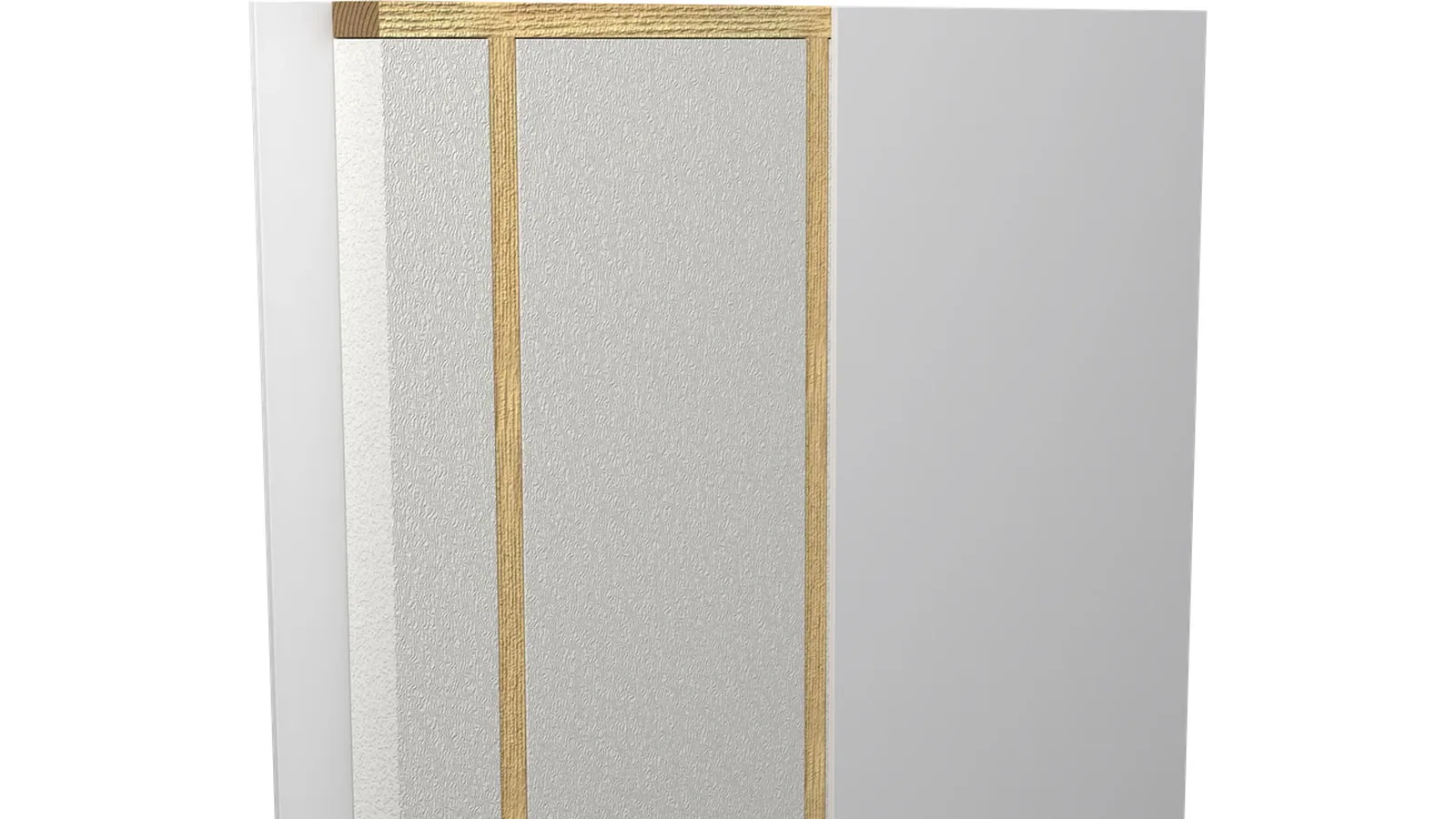
For noise coming from the neighbouring flat, an independent or semi-decoupled internal lining can be an effective solution. A material with an acoustic absorption function is placed in the cavity of the framework, while the finish serves to add mass. Perimeter joints and penetrations for sockets must be treated correctly, since a single unsealed area can significantly reduce the performance of the assembly.
The trade-off is space. Any internal lining takes up a few centimetres of the room, and better performance usually requires a deeper and more carefully decoupled framework. In a small bedroom, the decision must be taken after comparing the acoustic gain with the usable floor area lost.
Electrical sockets, junction boxes and pipes can become weak points. If two back boxes are installed back to back in separating walls, sound can pass through much more easily. Before the lining is closed, these details must be checked as part of the system, not treated as minor finishing interventions.
Ceilings and floors: how to address footsteps from above
When the main problem is footsteps from the floor above, a suspended ceiling can improve comfort, particularly if it is decoupled from the floor slab and includes an absorbent layer. Its effectiveness, however, varies according to the structure of the building and the intensity of the impact. A treated ceiling reduces part of the energy, but cannot completely eliminate vibrations transmitted through the flanking walls.
The highest-performing solution for impact noise is, as a rule, a floating floor installed in the flat above. The resilient layer reduces the transfer of vibrations to the floor slab, while the finish is separated from the vertical elements by a perimeter strip. It is a more extensive intervention, but it follows a simple technical logic: it treats the noise close to the point at which it is generated.
In one's own flat, a floor with a damping layer can reduce the noise transmitted to the neighbour below and can increase walking comfort. It is particularly relevant in complete renovations, before installing parquet, laminate flooring or other finishes.
Sealing and decoupling make the difference
Sound finds the gaps. Joints at the edge of a lining, spaces around pipes, cracks in masonry and doors with a large gap at the frame can limit the results even when the main materials have been well chosen. Elastic sealing, separating strips and the treatment of service penetrations are functional components, not mere accessories.
Decoupling is equally important. If a new framework is rigidly fixed to the vibrating element, part of the noise can bypass the absorbent material. Profiles, strips and fixing points must be selected so as to limit these acoustic bridges, while maintaining the necessary stability of the finish.
In flats, multifunctional systems offer a practical advantage. A single build-up can contribute simultaneously to noise attenuation, thermal comfort and vapour control, provided that the order of the layers is correct for the wall or ceiling concerned. Not every membrane is suitable for every position, and incorrect installation can promote concealed condensation within the structure.
When a technical assessment before installation is worthwhile
It is worth requesting a project-specific recommendation when the noise is persistent, when the renovation involves several areas or when there are services within walls and ceilings. State clearly where the sound comes from, when it is heard most loudly, what structure exists and what thickness can be allocated to the system. This information enables the selection of a predictable solution, rather than the purchase of a material at random.
At Isoflect, correct configuration starts from the installation area and the desired function: wall, floor, ceiling, building services or habitable attic. The materials must be regarded as an assembly - absorbent layer, separating element, sealing and protection against moisture, where the project requires it.
Successful sound insulation does not promise artificial silence. It creates absolute comfort within the real limits of the building: fewer interruptions, more privacy and a home that works for your rest, not against it. Before starting the renovation, identify the path of the noise and build the system around it.
Not sure which Isoflect product suits you? See Reflectiva Multistrat or open the package configurator to find out exactly what you need and in what quantity.